There’s a phrase doing the rounds in the FE sector right now that I can’t shake: “a very low pay award, possibly zero, may be the limit of affordability.”
Those words came from the Association of Colleges’ employment policy committee chair, at the first National Joint Forum meeting for the 2026-27 pay round. They were addressed to the unions representing college staff. They were, as the AoC chair acknowledged, not what anyone wanted to say.
But here’s the thing. When words like that land in a staff room, and they will, they don’t just carry a financial message. They carry a cultural one.
The numbers behind the signal
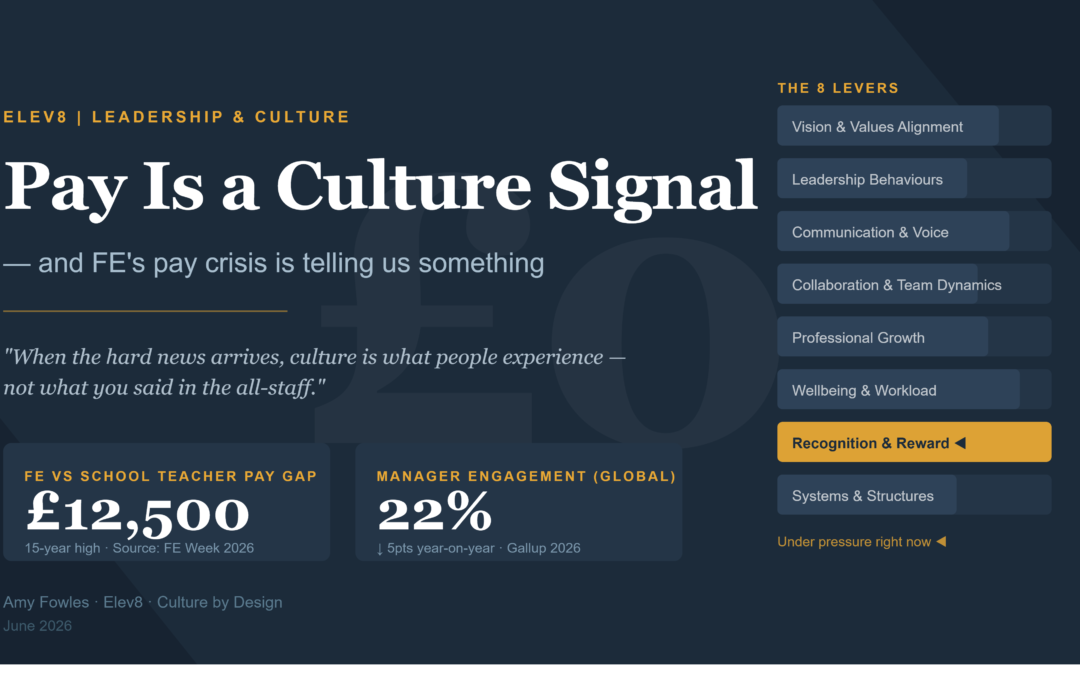
The context matters. The pay gap between FE lecturers and school teachers has now reached an estimated £12,500 a year, its highest point in fifteen years, according to FE Week. MPs on the education select committee recently concluded their future of FE inquiry by calling the sector “an engine left to run on fumes,” warning that “fifteen years of real terms funding cuts and stagnant pay have left colleges struggling to recruit and retain teachers who earn far less than their peers in schools.”
Five unions are demanding a 10% pay rise or £3,000 increase. Strike action looms. UCU put nearly 80 colleges on notice late last year following the AoC’s 4% pay recommendation. And now that 4% looks optimistic.
This is not a new problem. But a potential zero pay award in 2026-27 represents a threshold moment, one that will test the culture of every college and training provider in the sector.
What “zero” really communicates
I work with leaders across FE and skills on organisational culture, and one of the most consistent things I see is a disconnect between what leaders *intend* to communicate and what people *hear*.
Leaders often frame a poor pay outcome as: “We’re doing everything we can. The funding isn’t there. We feel your frustration.” They mean it sincerely. But what staff experience is something different. What lands is: *You are not our priority. This organisation does not reflect your worth back to you.*
Gallup’s 2026 State of the Global Workplace report found that just 21% of employees globally are engaged at work, down two points from the year before. The sharpest drop? Manager engagement, which fell five points between 2024 and 2025 (from 27% to 22%). As Gallup puts it, managers no longer enjoy an “engagement premium.” They’re as disengaged as the people they lead.
In a sector already stretched thin, where people regularly choose FE because they *care* about second chances, about vocational excellence, about learners who weren’t served well elsewhere disengagement is particularly costly. You can’t run a high-quality provision on goodwill alone.
Culture doesn’t wait for the funding settlement
Here’s what I want leaders to sit with: you can’t control the funding landscape. You can’t unilaterally close a £12,500 pay gap. But you can control how you *lead through it* and that leadership is a culture choice.
Culture by Design, the framework I use with clients, maps eight levers that shape how organisations actually feel to work in. Two are under direct pressure right now: Recognition & Reward, and Leadership Behaviours.
On recognition and reward: pay is the loudest signal, but it’s not the only one. When budgets are frozen, how are people still being seen and valued? Is there investment in development, in flexibility, in the quality of working life? Or has the leadership team retreated into finance conversations and left people to draw their own conclusions?
On leadership behaviours: Gallup’s data is unambiguous, 70% of team engagement is driven by the direct manager. Not the CEO’s Town Hall. Not the strategy document. The person people see every day. In a zero pay rise environment, the quality of the leadership relationship becomes the only lever that’s still fully available. That’s not a small thing. That’s everything.
The question every FE leader needs to ask
If your staff received the news of a zero or near-zero pay award this year, what story would they be telling each other in the car park? What story are you *giving* them to tell?
Culture is not what you say in an all-staff. It’s what people experience when the hard news arrives. It’s whether they feel their leader fought for them, was honest with them, stayed present with them, or whether they felt the silence speak louder than anything else.
The FE sector has given enormous amounts to learners and communities for a very long time, often on very little. The people doing that work deserve leaders who are visible, honest, and deeply intentional about culture, especially now, when the funding won’t do the work for them.
What are you doing this week to make sure your people know they are valued, even if the pay award can’t say it for you?
Amy Fowles is a leadership and culture consultant specialising in FE, skills and higher education. She works with organisations through ELEV8, using the Culture by Design framework and the 8 Levers of organisational culture.
Sources:
– College staff face zero pay rise warning — FE Week (https://feweek.co.uk/college-staff-face-zero-pay-rise-warning/)
– FE ‘engine’ running on fumes as MPs call for funding and pay reforms — FE Week (https://feweek.co.uk/fe-engine-running-on-fumes-as-mps-call-for-funding-and-pay-reforms/)
– FE teacher pay gap with schools hits 15-year high — FE Week (https://feweek.co.uk/fe-teacher-pay-gap-with-schools-hits-15-year-high/)
– State of the Global Workplace 2026 — Gallup (https://www.gallup.com/workplace/349484/state-of-the-global-workplace.aspx)